Thursday, 30 May 2019

Hand Hygiene and Handwashing


Hand Hygiene and Handwashing


(Microorganisms that are capable of causing infectious diseases are all around us. They can even be found on things and places we think are the cleanest. If our immune system drops, these pathogens may enter our system and may cause serious illnesses. However, transmission of these harmful microbes can be prevented through handwashing.)

                                    Description


Handwashing is the act of cleaning one’s hands with the use of any liquid with or without soap for the purpose of removing dirt or microorganisms. It is the most effective measure in reducing the risk of transmitting infectious diseases.
It cannot be said too often that hand washing is the most important and most basic technique in preventing and controlling infections. It is the single most effective infection control measure.

Terms


To understand this study guide better, familiarize yourself with the terms used:
  • Hand Hygiene. It is a general term that applies to handwashing, antiseptic handwash, antiseptic hand rub, or surgical hand antisepsis
  • Hand Washing. It is defined as the washing of hands with plain (i.e., non-antimicrobial) soap and water.
  • Antiseptic Handwash. A term that applies to handwashing with an antimicrobial soap and water.
  • Surgical Hand Antisepsis. Commonly called as a surgical hand scrub. This is to remove as many microorganisms from the hands as possible before the sterile procedure.

Concepts


Principles and concepts surrounding hand hygiene:
  • You must use running water in a sink that drains out instead of using a basin.
  • You may use soap – antibacterial soap if necessary.
  • You must rub your hands against each other for at least 30 seconds to facilitate removal of microorganisms.
  • Long nails and jewelry trap germs. It is best to keep fingernails short. If you wear a ring, it is better not to remove the ring before hand washing so that it can be washed too.
  • It is always better to use disposable paper towels than to use cloth towel when drying hands to ensure that you can only use those once.

Types of Hand Hygiene


The following are the types of hand hygiene:
  • Routine handwash. Use of water and non-antimicrobial soap for the purpose of removing soil and transient microorganisms.
  • Antiseptic handwash. Use of water and antimicrobial soap (e.g., chlorhexidine, iodine and iodophors, chloroxylenol [PCMX], triclosan) for the purpose of removing or destroying transient microorganisms and reduce resident flora.
  • Antiseptic handrub. Use of alcohol-based handrub.
  • Surgical antisepsis. Use of water and antimicrobial soap (e.g., chlorhexidine, iodine and iodophors, chloroxylenol [PCMX], triclosan) for the purpose of removing or destroying transient microorganisms and reduce resident flora. Recommended duration is 2-6 minutes.

Indicators of Hand Hygiene


According to the World Health Organization (WHO), there are Five Moments for Hand Hygiene:
  1. Before Patient Contact.
  2. Before and Antiseptic Task.
  3. After Body Fluid Exposure Risk.
  4. After Patient Contact.
  5. After Contact with Patient Surroundings.
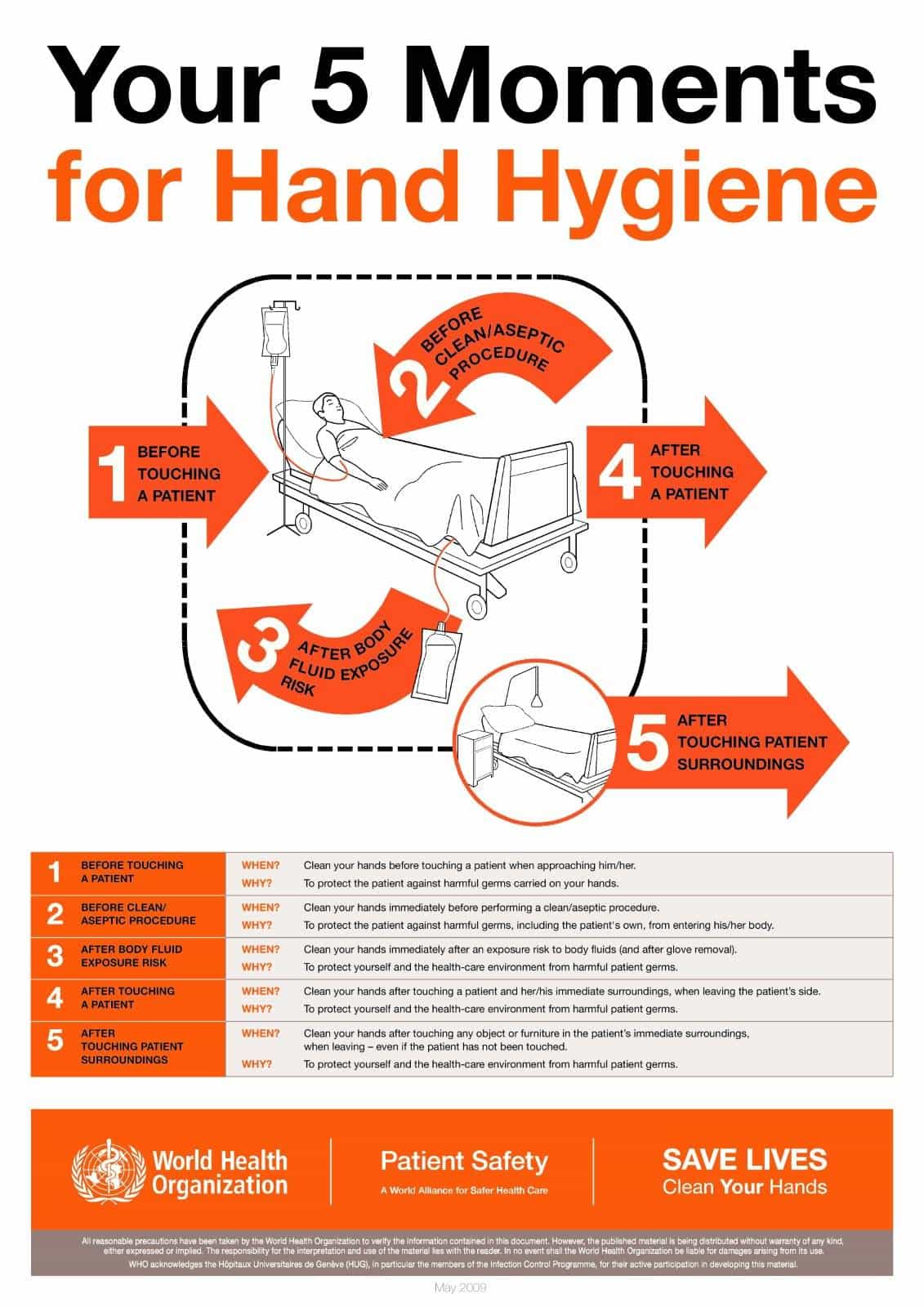
                       Hand Hygiene Moments. Image via: WHO.int


Procedures


Below are the step-by-step guide for different hand hygiene methods:

Antiseptic Handrub

The use of alcohol-based handrub.
1. Ensure jewellery has been removed
2. Apply quantity of alcohol-based hand hygiene product as per manufacturer’s recommendations into cupped hand.
3. Rub hands palm to palm
4. Right palm over left dorsum with interlaced fingers and vice versa.
5. Palm to palm with fingers interlaced
6. Backs of fingers to opposing palms with fingers interlaced
7. Rotational rubbing of left thumb clasped in right palm and vice versa
8. Rotational rubbing, backwards and forwards with clasped fingers of right hand in left
palm and vice versa
9. Rubbing hands together until hands are dry before continuing with patient care, do not rub off excess product

Antiseptic Handwash

Also known as clean technique, includes procedures used to reduce the number of organisms on hands.
1. Gather the necessary supplies. Stand in front of the sink.
2. Wet the hands and wrist area. Keep hands lower than elbows to allow water to flow towards the fingertips.
3. Cover all areas of hands with soap.
4. With firm rubbing and circular motions, wash the palms and backs of the hands, each finger, the knuckles, wrists, and forearms. Continue this friction motion for 30 seconds.
5. Rinse thoroughly with water flowing towards the fingertips.
6. Pat hands dry, beginning with the fingers and moving upward towards forearms, with a paper towel and discard immediately.
7. In the absence of sensors or foot pedal, use another clean paper towel to turn off the faucet.

Surgical Antisepsis

Also known as sterile technique, prevents contamination of an open wound, serves to isolate the operative area from the unsterile environment, and maintains a sterile field for surgery.
1. Remove all pieces of jewelry.
2. Wet hands using sterile water with water closest to your body temperature.
3. Wash hands using antimicrobial soap and/or povidone-iodine.
4. Clean subungual areas with a nail file.
5. Scrub each side of each finger, between the fingers, and the backs and fronts of the hands for at least 4 minutes.
6. Proceed to scrub the hands, keeping the hand higher than the arm at all times to prevent bacteria-laden soap and water from contaminating the hands.
7. Rinse hands and arms by passing them through the flowing water in one direction only, from fingertips to elbow.
8. Proceed to the operating room holding hands above elbows.
9. Dry hands and arms using sterile towel observing aseptic technique.


Normal Laboratory Values Guide

Normal Laboratory Values Guide

                                              Boosting value of lab testing services
Knowing the different normal lab values is an important step in making an informed clinical decision as a nurse. Diagnostic and laboratory tests are tools that provide invaluable insights and information about the patient. Lab tests are used to help confirm a diagnosis, monitor an illness, and the patient’s response to treatment.

Summary of Normal Laboratory Values

Summary of the different normal laboratory values. You can learn more about each diagnostic testing in the sections ahead.

Erythrocyte Studies

  • Red Blood Cell Count (RBC): Male adult: 4.5 – 6.2 million/mm3 ; Female adult: 4.5 – 5.0 million/mm3
  • Hemoglobin (Hgb): Male: 14-16.5 g/dL; Female: 12-15 g/dL
  • Hematocrit (Hct): Male: 42 – 52%; Female: 35 – 47%
  • Mean corpuscular volume (MCV): 78 – 100 μm3 (male) 78 – 102 μm3 (female)
  • Mean corpuscular hemoglobin (MCH): 25 – 35pg
  • Mean corpuscular hemoglobin concentration (MCHC): 31 – 37%
  • Serum iron: Male: 65 – 175 mcg/dL; Female: 50 – 170 mcg/dL
  • Erythrocyte sedimentation rate (ESR): 0 – 30 mm/hour (value may vary depending on age)

White Blood Cells and Differential

  • White Blood Cell (WBC) Count: 4,500 to 11,000 cells/mm³
  • Neutrophils: 55 – 70% or 1,800 to 7,800 cells/mm³
  • Lymphocytes: 20 – 40% or 1,000 to 4,800 cells/mm³
  • Monocytes: 2 – 8% or 0.0 to 800 cells/mm³
  • Eosinophils: 1 – 4% or 0.0 to 450 cells/mm³
  • Basophils: 0–2% or 0.0 to 200 cells/mm³
  • Bands: 0–2 % or 0.0 to 700 cells/mm³

Coagulation Studies

  • Platelet count (PLT): 150,000 to 400,000 cells/mm³
  • Activated partial thromboplastin time (APTT): 20 to 60 seconds, depending on the type of activator used.
  • Prothrombin time (PT): 11 – 13 seconds
  • Partial Thromboplastin Time (PTT): 25 – 35 seconds
  • International Normalized Ratio (INR): The INR standardizes the PT ratio and is calculated in the laboratory setting by raising the observed PT ratio to the power of the international sensitivity index specific to the thromboplastin reagent used.
  • Fibrinogen: 203 – 377 mg/dL
  • Bleeding time: 1 to 3 minutes (Duke method), 3 to 6 minutes (Ivy method)
  • D-Dimer: < 500 ng/mL

Serum Electrolytes

                                           Image result for  lab value
  • Potassium (K+): 3.5 – 5.0 mEq/L
  • Sodium (Na+): 135-145 mEq/L
  • Chloride (Cl-): 95 – 105 mEq/L
  • Calcium (Ca+):
    • Total calcium: 4.5 – 5.5 mEq/L (8.5 to 10.5 mg/dL)
    • Ionized calcium: 2.5 mEq/L (4.0 – 5.0 mg/dL) 56% of total calcium
  • Phosphorus (P): 1.8 – 2.6 mEq/L (2.7 to 4.5 mg/dL)
  • Magnesium (Mg): 1.6 to 2.6 mg/dL
  • Serum Osmolality: 280 to 300 mOsm/kg
  • Serum bicarbonate: 22 to 29 mEq/L

Renal Function Studies

  • Creatinine (Cr): 0.6 to 1.3 mg/dL
  • Blood urea nitrogen (BUN): 8 to 25 mg/dL

Glucose Studies

  • Glucose:
    • Glucose, fasting: 70 – 110 mg/dL
    • Glucose, monitoring: 60 – 110 mg/dL
    • Glucose, 2-hr postprandial: < 140mg/dL
  • Glucose Tolerance Test (GTT)
    • 70 – 110 mg/dL (baseline fasting)
    • 110 – 170 mg/dL (30 minute fasting)
    • 120 – 170 mg/dL (60 minute fasting)
    • 100 – 140 mg/dL (90 minute fasting)
    • 70 – 120 mg/dL (120 minute fasting)
  • Glycosylated hemoglobin (HbA1c)
    • 7% or lower (good control of diabetes)
    • 7% to 8% (fair control of diabetes)
    • Higher than 8 % (poor control of diabetes)
  • Diabetes Mellitus autoantibody panel: Less than 1:4 titer with no antibody detected

Arterial Blood Gases (ABGs)

  • Arterial blood pH: 7.35 – 7.45
  • Oxygen saturation (SaO2): >95%
  • Partial pressure of carbon dioxide (PCO2): 35 – 45 mmHg
  • Partial pressure of oxygen (PaO2): 80 – 100 mmHg
  • Bicarbonate (HCO3): 22 – 26 mEq/L

Liver Function Tests

  • Alanine Aminotransferase (ALT):
    • Male: 10 to 55 units/L
    • Female: 7 to 30 units/L
  • Aspartate Aminotransferase (AST):
    • Male: 10 – 40 units/L
    • Female: 9 – 25 units/L
  • Total bilirubin: 0.3 – 1.0 mg/dL
  • Direct bilirubin (conjugated): 0.0 to 0.2 mg/dL
  • Indirect bilirubin (unconjugated): 0.1 to 1 mg/dL; Critical level: > 12 mg/dL
  • Albumin: 3.4 to 5 g/dL
  • Ammonia: 35 – 65 mcg/dL (adult)
  • Amylase: 25 to 151 units/L
  • Lipase: 10 to 140 units/L
  • Protein: 6 to 8 g/dL

Lipoprotein Profile

  • Cholesterol: Less than 200 mg/dL
  • High-density lipoprotein (HDL): 30 to 70 mg/dL
  • Low density lipoprotein (LDL): Less than 130 mg/dL
  • Triglycerides: Less than 150 mg/dL

Cardiac Markers and Serum Enzymes

  • Creatine kinase (CK)
    • Male: 38 – 174 U/L
    • Female: 26 – 140 U/L
  • Creatinine kinase isoenzymes
    • CK-MM: 95% – 100% of total
    • CK-MB: 0% – 5% of total
    • CK-BB: 0%
  • Myoglobin: 5–70 ng/mL
  • Troponin:
    • Troponin: Less than 0.04 ng/mL; above 0.40 ng/mL may indicate MI
    • Troponin T: Greater than 0.1 to 0.2 ng/mL may indicate MI
    • Troponin I: Less than 0.6 ng/mL; >1.5 ng/mL indicates myocardial infarction
  • Atrial natriuretic peptide (ANP): 22 to 27 pg/mL
  • Brain natriuretic peptide (BNP): less than 100 pg/mL
  • C-type natriuretic peptide (CNP): reference range provided with results should be reviewed

HIV and AIDS Testing

  • CD4+ T-cell count:
    • Normal: 500 to 1600 cells/L.
    • Severe: Less than 200 cells/L
    • CD4-to-CD8 ratio: 2:1

Thyroid function test

  • Triiodothyronine (T₃): 80 to 230 ng/dL
  • Thyroxine (T₄): 5 to 12 mcg/dL
  • Thyroxine, free (FT₄): 0.8 to 2.4 ng/dL
  • Thyroid-stimulating hormone (thyrotropin): 0.2 to 5.4 microunits/mL

Urinalysis

  • Color: Pale yellow
  • Odor: Aromatic odor
  • Turbidity: Clear
  • Specific gravity: 1.016 to 1.022
  • pH: 4.5 to 7.8
  • Protein: Negative
  • Ketones: Negative
  • Bilirubin: Negative
  • Glucose: >0.5 g/day
  • Red blood cells: < 3 cells/HPF
  • White blood cells: < or = 4 cells/HPF
  • Bacteria: None or >1000/ml
  • Casts: None to few
  • Crystals: None
  • Uric acid: 250 to 750 mg/24 hours
  • Sodium: 40 to 220 mEq/24 hours
  • Potassium: 25 to 125 mEq/24 hours
  • Magnesium: 7.3 – 12.2 mg/dL

Hepatitis Testing

  • Hepatitis A: Presence of immunoglobulin M (IgM) antibody to Hepatitis A and presence of total antibody (IgG and IgM) may suggest recent or current Hep A infection.
  • Hepatitis B: Detection of Hep B core Antigen (HBcAg), envelope antigen (HBeAg), and surface antigen (HBsAg), or their corresponding antibodies.
  • Hepatitis C: Confirmed by the presence of antibodies to Hep C virus.
  • Hepatitis D: Detection of Hep D antigen (HDAg) early in the course of infection and detection of Hep D virus antibody in later stages of the disease.
  • Hepatitis E: Specific serological tests for hepatitis E virus include detection of IgM and IgG antibodies to hepatitis E.

Therapeutic Drug Levels

  • Acetaminophen (Tylenol): 10 to 20 mcg/mL
  • Carbamazepine (Tegretol): 5 to 12 mcg/mL
  • Digoxin (Lanoxin): 0.5 to 2 ng/mL
  • Gentamicin (Garamycin): 5 – 10 mcg/mL (peak); <2.0 mcg/mL (trough)
  • Lithium (Lithobid): 0.5 to 1.2 mEq/L
  • Magnesium sulfate: 4 to 7 mg/dL
  • Phenobarbital (Luminal): 10 to 30 mcg/mL
  • Phenytoin (Dilantin): 10 to 20 mcg/mL
  • Salicylate: 100 to 250 mcg/mL
  • Theophylline: 10 to 20 mcg/dL
  • Tobramycin (Tobrex): 5 – 10 mcg/mL (peak); 0.5 – 2.0 mcg/mL 
  • Valproic acid (Depakene): 50 – 100 mcg/mL
  • Vancomycin (Vancocin): 20 – 40 mcg/mL (peak); 5 – 15 mcg/mL